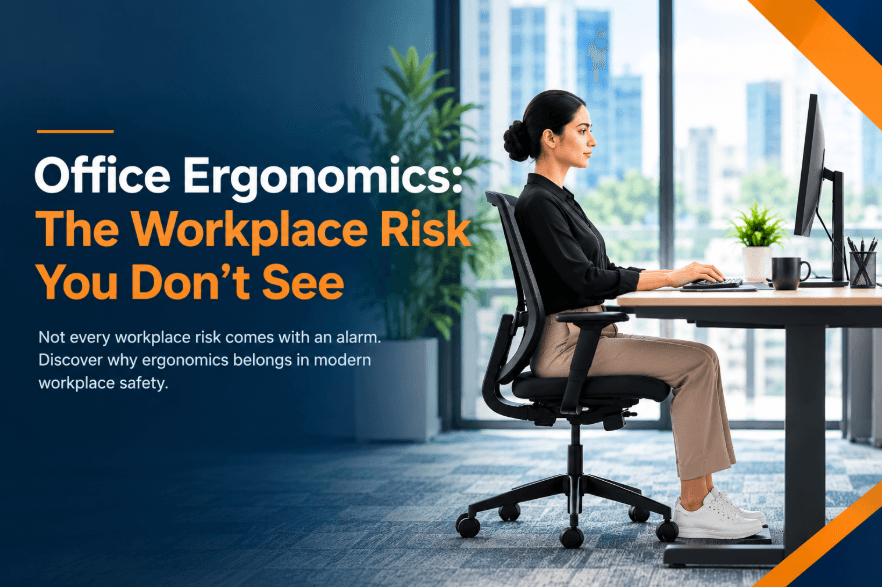
Office Ergonomics: The Workplace Risk You Don’t See
Not every workplace risk comes with an alarm. Poor posture, badly positioned screens, prolonged sitting, and repetitive movements can quietly affect employees every day. Discover why ergonomics belongs in modern workplace safety.
Office Ergonomics: The Risk Hiding in Plain Sight
Most workplace hazards announce themselves a fire alarm rings, an emergency exit is marked, and safety equipment is clearly visible. Ergonomic risks are different. They quietly develop while an employee works at the same desk, in the same position, for hours every day. A raised shoulder, unsupported back, poorly placed screen, or wrist bent over a keyboard may seem insignificant, but repeated strain can gradually turn into persistent discomfort, reduced concentration, and lower productivity.
Office ergonomics is not about forcing every employee into one “perfect” posture. It is about creating a workstation that supports the individual and allows the body to work without unnecessary stress. The screen, chair, desk, keyboard, lighting, and movement routine should work together. Employees should also be encouraged to recognize early signals such as neck stiffness, shoulder tension, back pain, wrist discomfort, or tired eyes instead of accepting them as “just part of office work.”
An ergonomic problem rarely begins with a major incident. It begins with small compromises repeated every day: a chair that cannot be adjusted, a laptop used without proper height support, a mouse positioned too far away, or meetings held continuously without movement. Over time, these habits can affect comfort, focus, attendance, and employee performance. Preventive action is therefore not an optional workplace upgrade it is a practical investment in the health and effectiveness of the workforce.
A strong ergonomics culture also depends on employee participation. Managers must make it easy for employees to report discomfort, request workstation adjustments, and take short movement breaks without feeling unproductive. Organizations should regularly assess workstations, provide practical guidance, and track improvements instead of treating ergonomics as a one-time awareness activity.
At Secure Place™, we help organizations make invisible workplace risks visible. Through our Office Ergonomics & Posture Safety approach, organizations can assess workstations, educate employees, and turn observations into practical improvements. Because a safe workplace is not only one that responds well when an emergency occurs - it is one that protects employees during every ordinary working hour. Assess. Prepare. Protect.
- #office ergonomics
- #workplace safety
- #ergonomic assessment
- #posture safety
- #employee wellbeing
- #workplace preparedness
- #office safety
Found this useful? Share it with your network.
How does your workplace measure up?
Twenty questions, two minutes, a score out of 100 and your three biggest gaps.